

How to accurately measure noise and ripple on microcontroller power supply circuits?
Power in an integrated circuit design is a tightly controlled commodity. As the affordable microcontroller market has exploded, there have been increasing demands on power distribution networks, resulting in lower supply voltages. Lowering the supply voltages helps to reduce power consumption. Many designs today have 3,3 V, 1,8 V and even a 1,1 V supply, and as those supplies have become smaller, so have the tolerances on those supplies. Tolerances have dropped from 10% to “1% - 5%”.
_402_x_600.png)
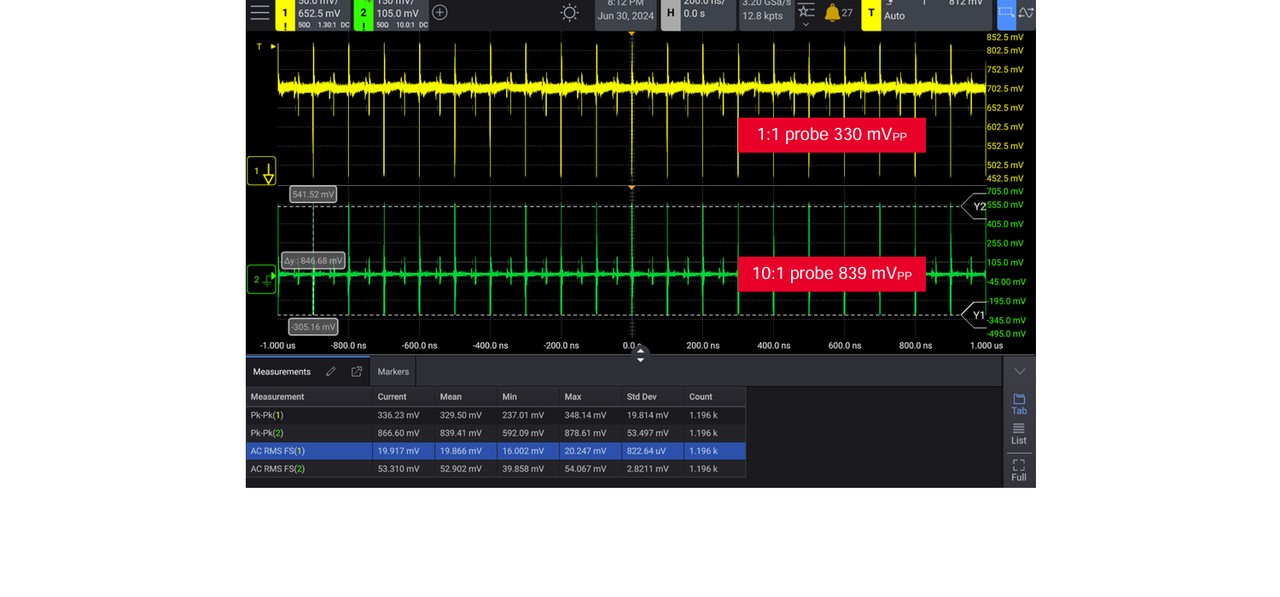
You must scrutinize DC power rails and voltage lines for quality and integrity. Ripple, noise and transients are riding on those voltage rails, and before you can reduce them, you need to measure them. The goal is to make sure that the power rail is clean. Fundamentally, you need to measure ever smaller and faster AC signals riding on top of the DC ones.
_287_x_770.png)
Using the Keysight N7020A power rail probe and the 14-bit Keysight HD3 Series oscilloscope makes it easier to find and analyze the AC signals of your DC power supply that you were unable to see before. Check below application note „5 Tips for Measuring Ripple and Noise“ how to test power rails in your design as accurately as possible.
Documents for dowload:
-
 5 Tips for Measuring Ripple and Noise – Application note
size: 1.91 MB
5 Tips for Measuring Ripple and Noise – Application note
size: 1.91 MB
-
Keysight HD304MSO – Technical specifications
size: 1.55 MB
-
Keysight N7020A power rail probe 2 GHz
size: 7.54 MB

























H TEST a.s.
Šafránkova 3
155 00 Praha 5
+420 235 365 207
+420 235 365 204
Newsletter
Product news, invitations for fairs, seminars and trainings. We send electronically max. 3 times/month.
© 2026 H TEST a.s.
Created by eBRÁNA s.r.o. | Powered by CMS WebArchitect | SEO a internetový marketing